On this page
- Quick Recap
- 1. Give Each Part of the Ad One Job
- 2. Lead With the Benefit, Then Prove It
- 3. Write the First Line for Someone Who Is Scrolling
- 4. Match the Copy to What the Buyer Already Knows
- 5. Describe the Situation, Not the Person
- 6. Make the Next Step and Any Urgency Honest
- 7. Plan the Video Copy and the Text Copy Together
- Facebook Ad Copy Examples You Can Adapt
- How to Test Your Ad Copy
- How to Write the Hook, Script and On-Screen Text Together
- Final Thoughts
- FAQs
Quick Recap
- Each field in a Facebook ad has its own job: the primary text hooks and explains, the headline carries the offer, and the words on the video stop the scroll with the sound off.
- The first line of primary text matters most, because it's the part a scrolling buyer actually reads, and Meta's own guide suggests keeping the whole text to 50 to 150 characters.
- Benefit-first copy works when a concrete detail backs the benefit up, such as a number the product page can prove.
- Meta's ad rules don't allow copy that asserts or implies a personal attribute such as a health condition or financial status, so the copy should describe a situation, not the person.
- Video ad copy works best when the on-screen text, the first spoken line, the primary text and the headline tell the same story.
1. Give Each Part of the Ad One Job
A Facebook ad has more text fields than most writers plan for, and each field shows up at a different moment. Copy that repeats the same sentence in every field wastes most of the space:
| Where it shows | Its job | |
|---|---|---|
| Primary text | Above the image or video | The hook and the main benefit; Meta suggests 50 to 150 characters |
| Headline | Under the media, next to the button | The offer or the main benefit; Meta suggests 27 characters |
| Description | Under the headline, on some placements only | One supporting detail: shipping, guarantee or price |
| Call-to-action button | Bottom right | The action, such as "Shop now" or "Learn more" |
| Text on the video | Inside the video | The hook in a few words, readable with the sound off |
| Spoken lines | In the video's audio | The story, for people who turn the sound on |
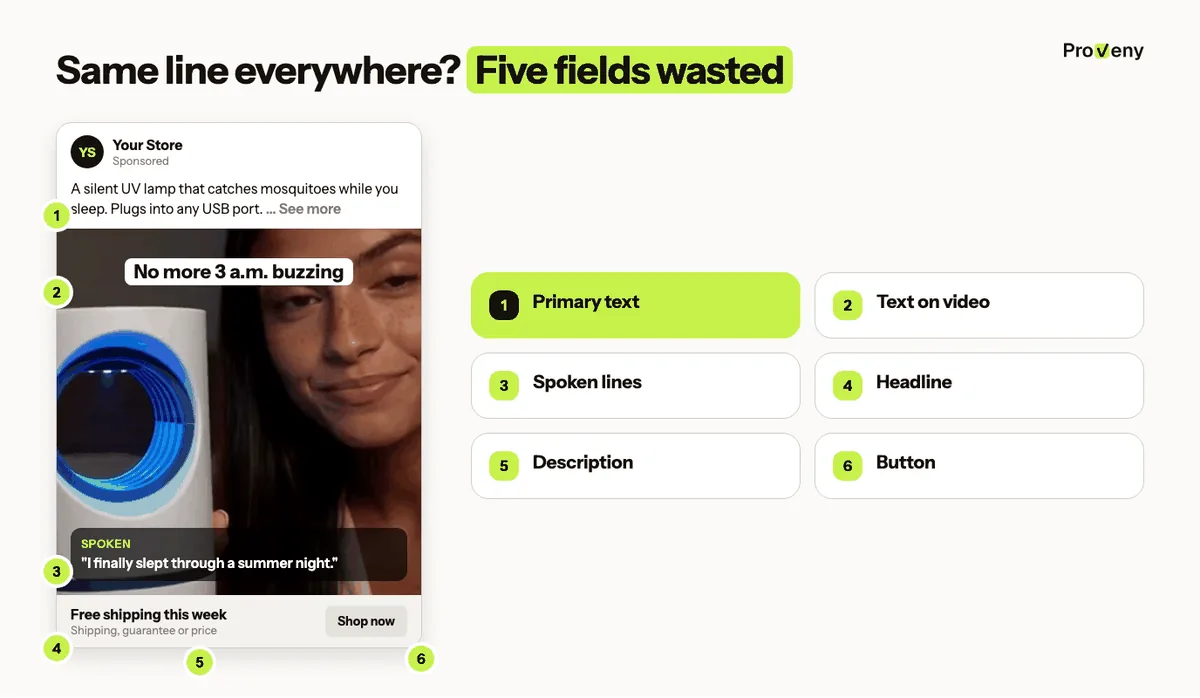
On Reels and Stories, the video fills nearly the whole screen, so the text on the video carries most of the message.
2. Lead With the Benefit, Then Prove It
People buy what a product does for them, not its spec sheet. "Dinner on the table in 15 minutes" tells a buyer why they'd care; "1,500 W motor" only makes sense once they already do.
The feature still has a place, right after the benefit, as proof. A line like "Keeps coffee hot for 6 hours, thanks to a double steel wall" gives the reader a reason to want it and a reason to believe it.
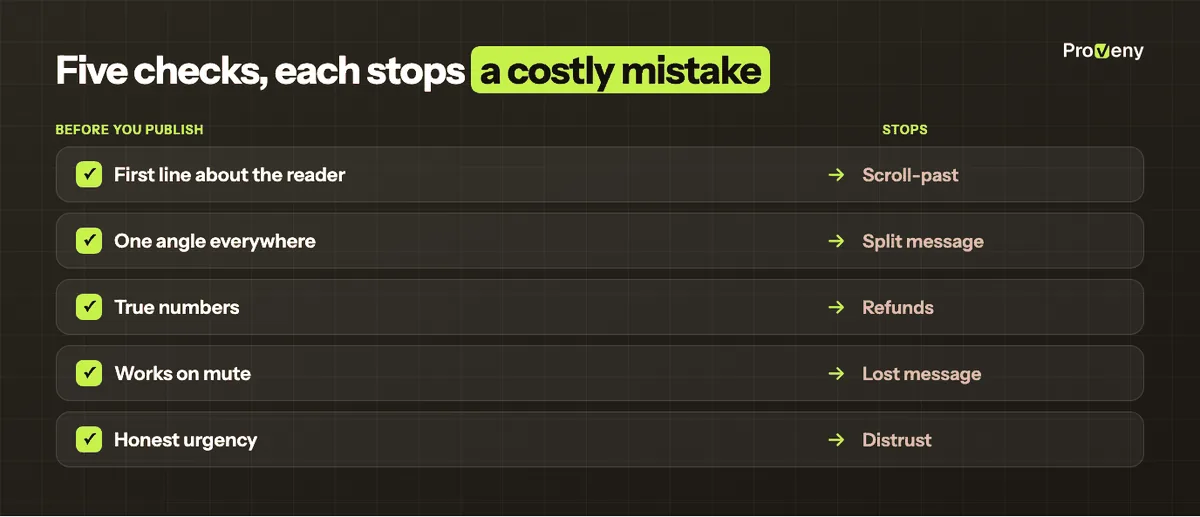
Specific numbers do the same job: "holds 12 cups" beats "large capacity". The one condition is that every number must be true and appear on the product page, because a buyer who checks and can't find it stops trusting the rest of the ad.
3. Write the First Line for Someone Who Is Scrolling
A buyer in the feed reads the primary text the way they read everything else there: a glance at the start, then a decision. That first line decides whether anyone reads the second one.
A strong first line is about the reader's problem or wish, not about your brand. Here are two openings for the same pet hair glove:
- Brand first: "Introducing the new PetPro grooming glove, our best seller."
- Reader first: "Dog hair on the sofa again, an hour after you cleaned?"
The second one names a moment the right buyer recognizes at once, and anyone without a dog keeps scrolling, which is fine. Our guide to TikTok hooks has more opening patterns that carry over to Facebook.
4. Match the Copy to What the Buyer Already Knows
The same product needs different copy depending on how much the reader knows. Someone who has never thought about the problem needs to see it first, while someone who already knows your product mostly needs a reason to buy today.
Here is how one product, a self-heating mug, might read at each stage:
| Copy leads with | Example first line | |
|---|---|---|
| Nothing yet (cold audience) | The problem | "Your coffee goes cold while you answer one email." |
| The problem, not the solution | The fix | "A mug that keeps coffee at the same heat until the last sip." |
| The product | Proof and detail | "Holds 350 ml at one temperature for the whole morning." |
| Your store | The offer | "Back in stock, with free shipping this week." |
Most product tests run on cold audiences, so new ads usually start in the first row, while retargeting ads can skip to the bottom two.

Drama, UGC or demo ads. Any concept, any product.
Every ad shows your product working accurately.
5. Describe the Situation, Not the Person
Meta's advertising standards say ads must not assert or imply personal attributes, such as physical or mental health, vulnerable financial status, age, race, religion or sexual orientation. Meta's own examples of copy that breaks the rule include "Do you have diabetes?" and "Are you bankrupt?", even when the product really helps.
The fix is to move the copy from the person to the situation. A few examples:
- Not allowed: "Do you have back pain?"
- Allowed: "A chair cushion built for long days at the desk."
- Not allowed: "Drowning in debt?"
- Allowed: "A budget planner that shows where every dollar goes."
Health and weight-loss products have their own, stricter section in Meta's standards. Either way, a result the product can't back with evidence doesn't belong in the copy.
6. Make the Next Step and Any Urgency Honest
The last line should tell the reader what happens when they tap. "Learn more" is vague; "See the colors" or "Get yours with free shipping" sets a clear expectation, and the button should ask for the same action.
Urgency works when it's real. A sale that ends on Sunday or a batch that's genuinely limited gives people a reason to act now. A countdown that resets every time someone reloads the page does the opposite: buyers notice, and the comment section tells everyone else.
7. Plan the Video Copy and the Text Copy Together
Most ad copy advice treats copy as the text above an image. In a video ad, the words live in four places at once, and buyers see them in a fixed order: the text on the first frame, the first spoken line, then the primary text and headline if they're still interested.
Each place has a different job, and all four should push the same angle. Here is a set written together for a plug-in mosquito lamp, with the angle "sleep through the night":
| Job | Example | |
|---|---|---|
| Text on video (0 to 3 s) | Stop the scroll, sound off | "No more 3 a.m. buzzing" |
| First spoken line | Hook for sound-on viewers | "I finally slept through a summer night." |
| Primary text | Benefit and proof for readers | "A silent UV lamp that catches mosquitoes while you sleep. Plugs into any USB port." |
| Headline | The offer | "Free shipping this week" |
The common mistake is switching angles halfway: if the video sells better sleep, a primary text about saving money makes it feel like two ads stitched together. For the visual side of the same story, see our guide to the product demo video.
Facebook Ad Copy Examples You Can Adapt
The four frameworks below cover most product ads. Each example is written for an illustrative product, not taken from a real brand's ad. For real copy from your niche, the Meta Ad Library shows what competitors run, and Proveny's Meta ad downloader saves each video ad with its primary text, button and landing page, so you can compare frameworks side by side.
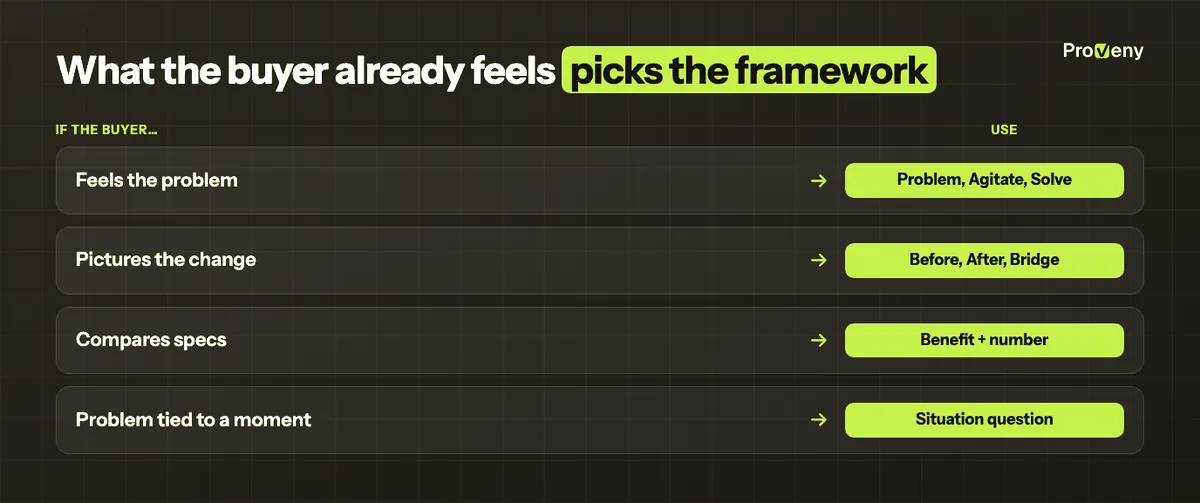
Problem, Agitate, Solve
This one names the problem, makes it felt, then shows the fix:
Example
Cold coffee again? You poured it 20 minutes ago and forgot. This mug keeps it at one temperature until the last sip.
Before, After, Bridge
The reader sees life before, life after, and the product as the bridge between them:
Example
Before: a drawer of tangled chargers. After: one cable for each device, in its place. The magnetic organizer sticks under any desk.
Benefit Plus Number
One clear benefit, made concrete by a number the listing backs up:
Example
Clean the whole car interior in 10 minutes. Cordless, four heads, fits in the glovebox.
Question About a Situation
A question the buyer answers with "yes", about a moment rather than about them:
Example
Dog hair on every sofa cushion? One stroke with this glove lifts it off, and it rinses clean under the tap.
How to Test Your Ad Copy
Meta's multiple text optimization lets you add up to five versions of the primary text, headline and description to one ad, then favors the versions that work for your audience. That's a cheap way to see which angle in the copy gets the most response, but it mixes several changes at once.
A clean answer comes from changing one thing: the same video with two different primary texts, judged on clicks and purchases rather than likes. The video itself usually moves results more than the copy does, though, so the creative deserves the first test. Our guide to ad creative testing covers how to set that up.
How to Write the Hook, Script and On-Screen Text Together
Practice seven is the hardest one to follow by hand. The script usually comes from one person, the on-screen text from an editor and the primary text from whoever launches the ad, so the angle drifts.
Proveny is an AI ad generator for product video ads, and it writes those pieces together. You paste a product link or upload photos, Proveny reads how the product is used and suggests an angle built around one key action, then writes the script, spoken lines and captions for that angle. Each angle is also built with a list of claims the ad must not make, which keeps the copy inside what the listing supports.
Every line stays editable before the video renders, so the hook, the spoken lines, the captions and the angle you'll echo in the primary text are settled in one place.


Drama, UGC or demo ads. Any concept, any product.
Every ad shows your product working accurately.
Final Thoughts
Good ad copy is less about clever lines than about one angle, told in every field with a job of its own. The benefit leads, a true detail proves it, and the opening is written for someone mid-scroll who knows only what they know so far.
The rest is restraint: situations instead of personal traits, urgency only when it is real, and a video whose first words agree with the text around it. Once that angle is clear, testing copy becomes a choice between two good options.
 HC
Written by
Founder of Proveny & TrueProfit
Harry Chu has spent 11 years in eCommerce doing the work behind the growth: running ads, testing creatives, reading the numbers, and scaling his own Shopify stores to 7 figures. He knows a good-looking ad account doesn’t mean much if the store isn’t growing.
Harry is the founder of Proveny and TrueProfit. On the Proveny blog, he shares what he’s learned from building and scaling his own stores: what to test, what the results actually mean, and when it’s time to stop spending on an idea that isn’t working.
No magic formula. No advice from the sidelines. Just practical lessons from someone who has had to make the numbers work in his own business.
More lessons from Harry