On this page
- Quick Recap
- TikTok Hooks at a Glance
- 1. Problem First
- 2. Result First
- 3. Curiosity
- 4. Doubt
- 5. Talk to One Person
- 6. Specific Claim
- 7. Mistake or Warning
- 8. Social Proof and Reaction
- Why the First Frame Matters More Than the First Line
- How to Test TikTok Hooks Without Remaking the Ad
- How to Get Several Hooks for One Product Without a Reshoot
- Final Thoughts
- FAQs
Quick Recap
- A TikTok hook is the first few seconds of the ad, made of what the viewer sees, hears and reads, and all three should say the same thing.
- The visual carries the hook for physical products, because a product in motion reads before any sentence finishes.
- Each hook type fits a different buyer: problem-first for people who know the pain, curiosity for products nobody has seen, doubt for products that look too good to be true.
- A fair hook test keeps the body of the ad identical and changes only the opening, then reads early views against impressions alongside clicks.
- A hook that wins views but not clicks promises something the rest of the ad doesn't deliver.
TikTok Hooks at a Glance
Here are the eight hook types side by side, with when each one fits and the visual to pair it with:
| Hook type | Use it when | Visual to pair | |
|---|---|---|---|
| 1 | Problem first | The buyer already knows the pain | The problem in motion |
| 2 | Result first | The "after" looks striking | The finished result, then the rewind |
| 3 | Curiosity | The product is new or odd | An extreme close-up |
| 4 | Doubt | The product looks too good to be true | A hard test |
| 5 | Talk to one person | The buyer is a clear group | That person's real setting |
| 6 | Specific claim | You can prove a number | The proof on screen |
| 7 | Mistake or warning | Buyers do a task the hard way | The wrong way, then the right way |
| 8 | Social proof and reaction | The product gets noticed | A real reaction |
Words in [brackets] are placeholders for your product, buyer or result.
1. Problem First
A problem-first hook names a pain the viewer already has, so the people who stop are the people who might buy. It works best when the problem is common and easy to film, like pet hair, tangled cables or a cold coffee.
Four templates for this type:
- "If you [have this problem], watch this."
- "I was so tired of [problem] that I tried this."
- "Nobody talks about how annoying [problem] is."
- "This is why your [thing] keeps [going wrong]."
The picture under the line should show the problem happening, not a person describing it.
2. Result First
A result-first hook opens on the finished state, then rewinds to show how it happened. The viewer stays to see the method, which is exactly where the product does its job.
Four templates for this type:
- "This is what [item] looks like after 10 seconds with this."
- "[Result] in [short time]. Here's how."
- "Same [thing], five minutes apart."
- "I haven't [had the problem] since I got this."
The time in the line has to match what the product really does, because the rest of the ad is about to show it.
3. Curiosity
A curiosity hook works when the product is unusual enough that the viewer wants to know what it is. It suits new gadgets and products from categories most people have never seen.
Three templates for this type:
- "I found the weirdest [product type] online."
- "I didn't know this existed until last week."
- "What does this button do?"
An extreme close-up fits this type well, since the viewer can't tell what the object is until the camera pulls back.
4. Doubt
A doubt hook says the viewer's suspicion out loud and then tests it. Products that look too good to be true sell better when the ad admits that first.
Four templates for this type:
- "I thought this was a gimmick."
- "Let's see if this actually works."
- "I bought this so you don't have to."
- "Honest review after [two weeks]."
The test that follows has to be real and a little harsh, or the hook turns against the product.
5. Talk to One Person
This type calls out a specific buyer, so the right people feel the ad was made for them. It fits products with an obvious owner, like dog walkers, drivers, new parents or home cooks.
Four templates for this type:
- "If you're a [buyer type], you need this."
- "POV: you finally [solved problem]."
- "Every [dog owner / driver / parent] needs to see this."
- "Tell me you [habit] without telling me."
The setting matters here: a car interior for drivers, a park for dog walkers.
6. Specific Claim
A specific claim hook uses a number or a concrete result instead of an adjective. "This replaced three things in my kitchen" is easier to believe than "this is amazing", because it can be checked.
Three templates for this type:
- "This replaced [number] things in my [room]."
- "The [product] that [specific result] in [specific time]."
- "I've tried [number] of these. This is the only one I kept."
Every number in a claim hook has to be true for your product and match the listing, since buyers and comments will test it.
Drama, UGC or demo ads. Any concept, any product.
Every ad shows your product working accurately.
7. Mistake or Warning
A warning hook tells the viewer they're doing something the hard way. It works when your product replaces a common habit, such as wiping, scrubbing or untangling by hand.
Three templates for this type:
- "Stop [common habit] and do this instead."
- "You've been [doing task] wrong."
- "The biggest mistake I made with [task]."
The strongest version shows the wrong way briefly, then the product doing it right.
Why the First Frame Matters More Than the First Line
Most hook lists are written for creators, so they focus on the spoken line. In a product ad, the product can hook on its own before anyone talks. Every hook has three layers, and for a product the visual one does the most work:
| What it is | Example | |
|---|---|---|
| Visual | What the viewer sees in frame 1 | The product doing its key action, close up |
| Spoken | The first line | "I thought this was a gimmick." |
| Text | Words on screen | "POV: you stopped buying paper towels" |
When the three layers say the same thing, the hook lands even if the viewer misses one of them. TikTok recommends 5 to 10 words per second for text, so an opening caption of about six words is enough.
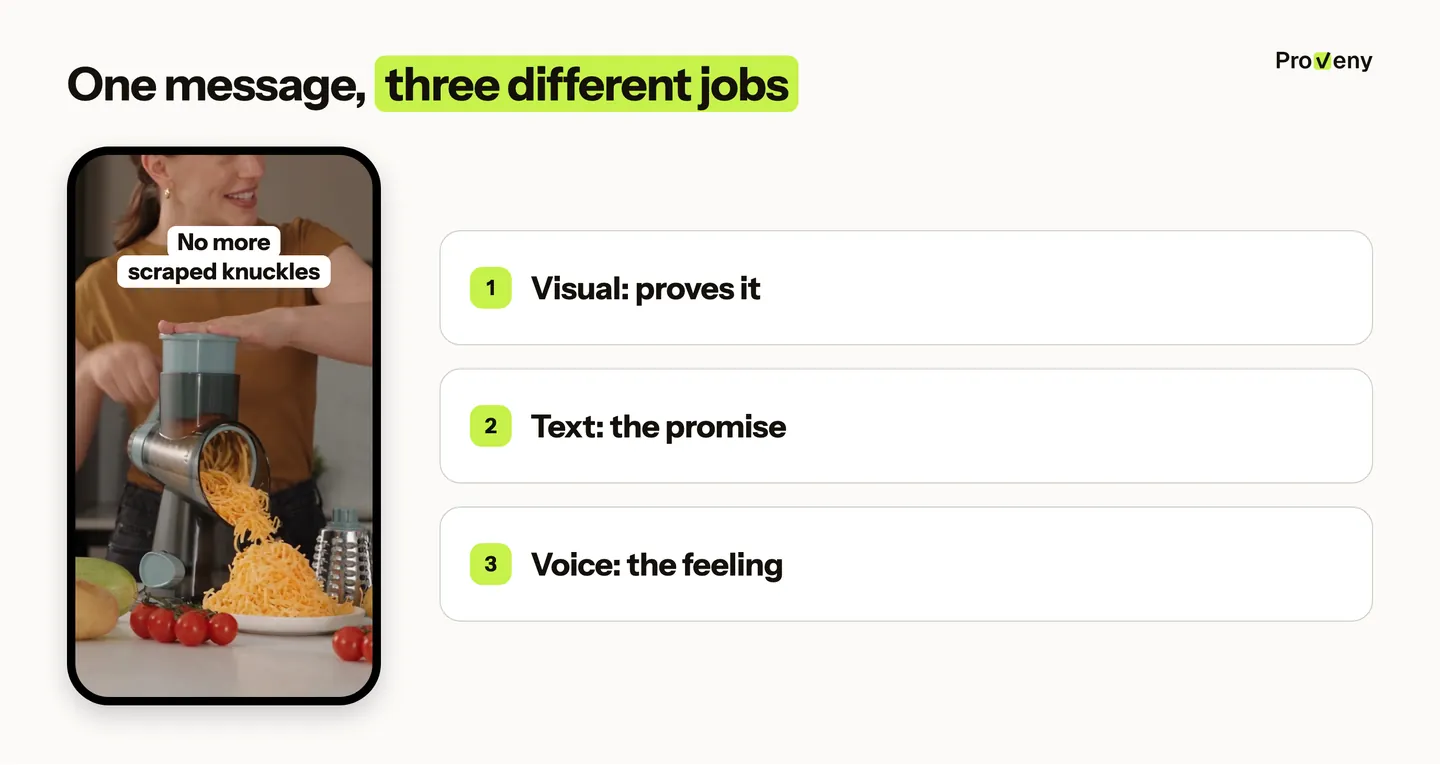
Five visual openings work for almost any physical product:
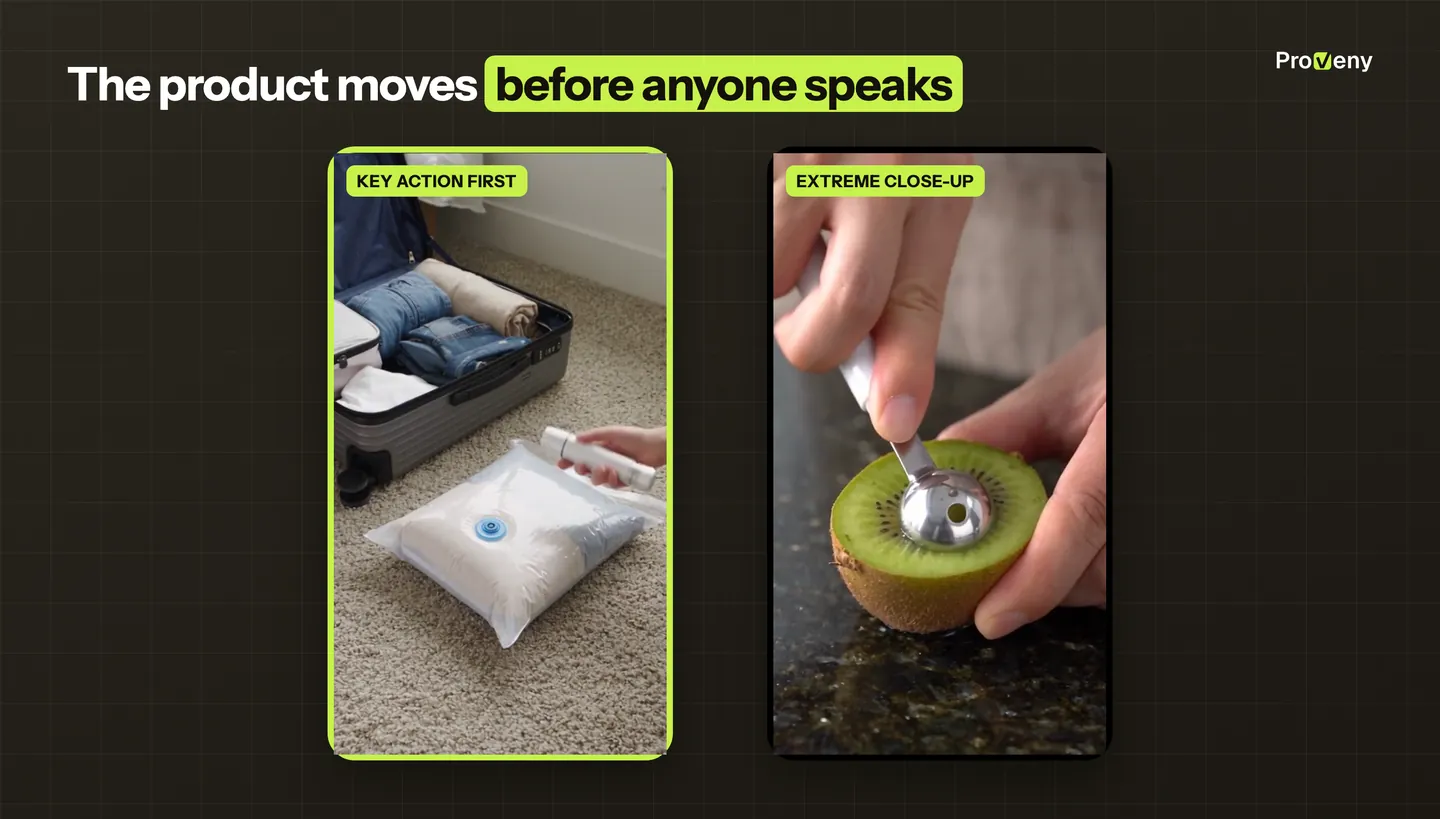
- Key action first: the ad starts in the middle of the action, such as the clip snapping or the lid sealing.
- Result first: the clean, fixed or finished state, then a rewind to how it happened.
- Problem in motion: the mess, the leak or the tangle happening right before the product appears.
- Extreme close-up: a detail so close the viewer can't tell what it is until the camera pulls back.
- Unexpected place: the product used where nobody expects it, like a car, a tent or a shower.
The two Proveny ads below show the idea. In one, frame 1 is a vacuum pump already on a bag of clothes, and the bag goes flat before the first line ends. In the other, two hands scoop a kiwi into a ball with a melon baller, no words needed.
Our guide to product demo videos covers how to find that key action.
How to Test TikTok Hooks Without Remaking the Ad
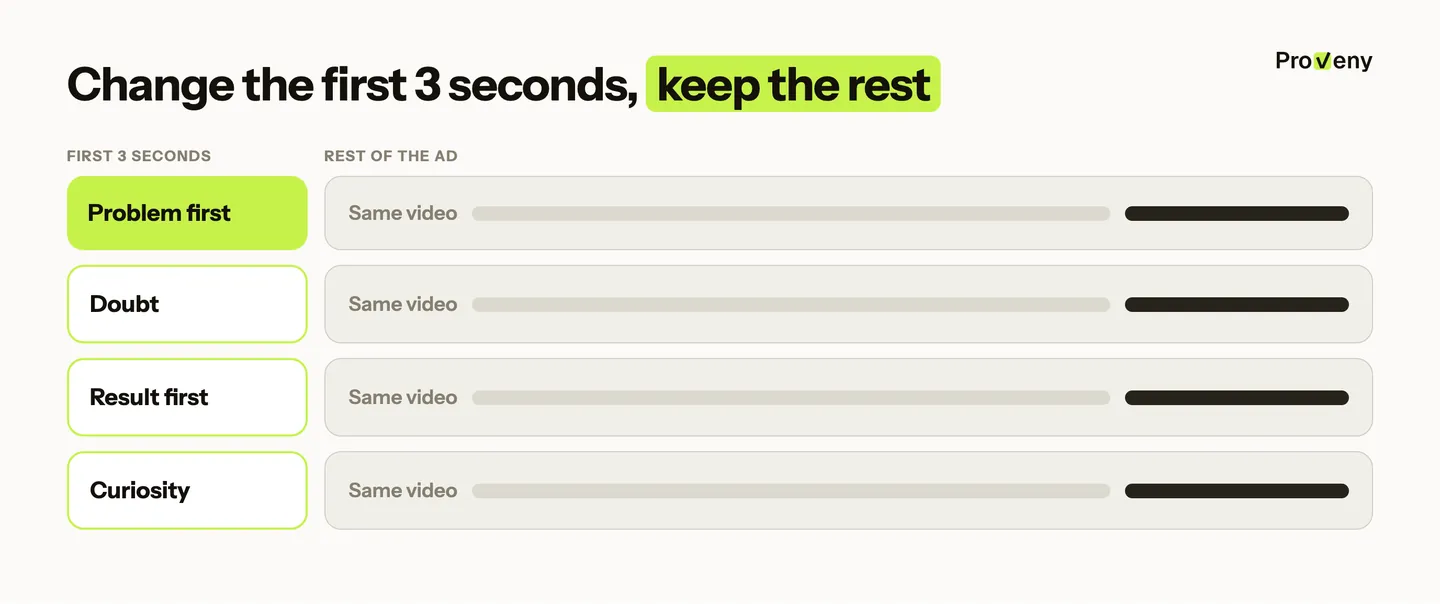
Hooks are the cheapest part of an ad to test, because the body of the video stays the same. That also makes the test fair: if only the opening changes, any difference in results comes from the opening. The steps:
- Make three to five versions that differ only in the first 3 seconds, using different hook types for the same angle.
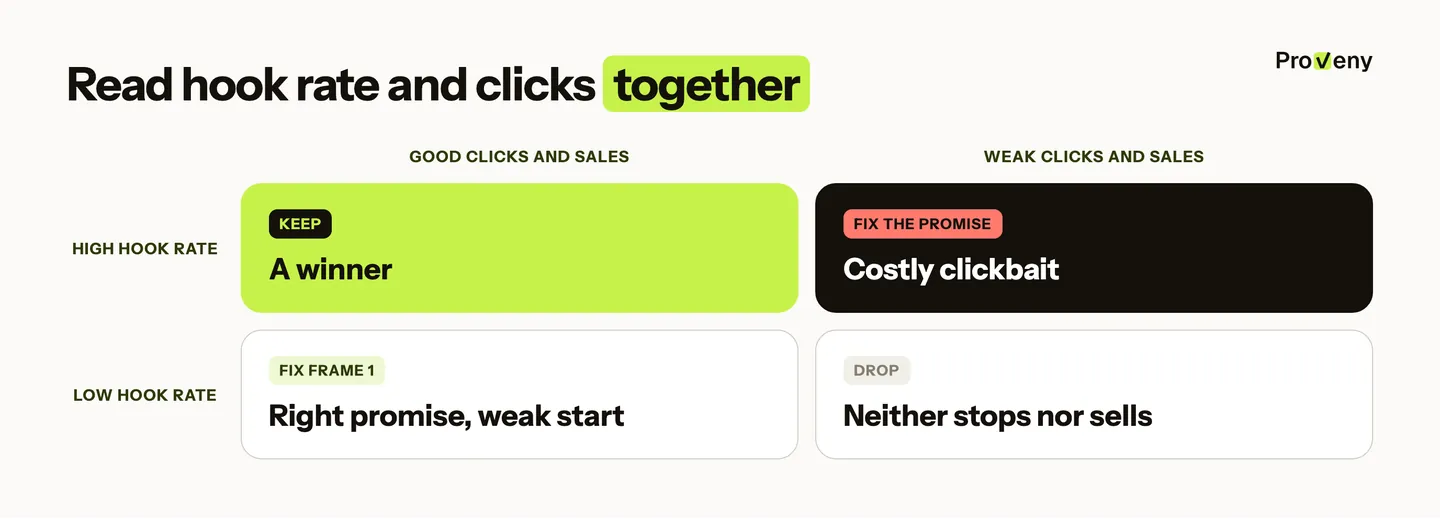
- Read early views against impressions. On TikTok, that's 2-second or 6-second video views divided by impressions. On Meta, it's 3-second video plays divided by impressions, often called hook rate.
- Check what happens next. A hook with high early views but weak click-through is promising something the rest of the ad doesn't deliver.
- Log the winning hook type per product. After a few products, patterns appear, such as doubt hooks winning for gadgets.
Meta counts a 3-second play only when the video plays for at least 3 seconds (or nearly all of a shorter video), and replays don't count, so the number is a clean read of the opening.
Our guide to ad creative testing covers budgets and test length, and the ad fatigue guide covers when to replace a winning hook that slows down.
How to Get Several Hooks for One Product Without a Reshoot
The strongest product hooks open on the key action, and a fair test needs several of them for the same product. Filming each opening takes the product in hand and another shoot, while many AI ad tools animate a single product photo, which rarely shows the product moving the way it really does.
That's the problem Proveny is built to solve. You paste a product link from AliExpress, Shopify or another store, or upload product photos, and Proveny reads the specs, how the product is used and its images. Each angle it suggests is built around what the ad opens on and the one key action the product performs, and you can change the script before anything renders.
Two features matter most for hook testing:
- Several angles from one link: the chat writes three different selling angles for each product, each with its own opening, so you get real differences to test, not three copies of one.
- Reshoot one segment: when only the opening fails, the video editor remakes that one segment and keeps the rest.
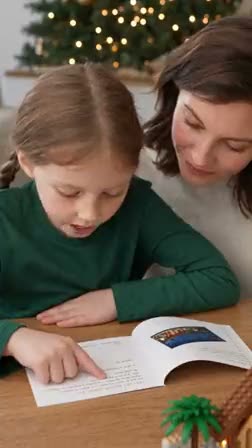
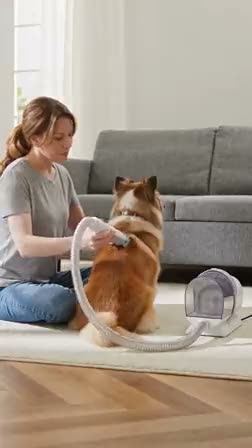
Drama, UGC or demo ads. Any concept, any product.
Every ad shows your product working accurately.
Final Thoughts
A TikTok hook has a few seconds to make the viewer stay, and for a product ad the fastest way to do that is to show the product doing something.
The eight hook types cover the most common kinds of buyer, from people who know the problem to people who doubt the product. Each works best with its paired visual, and every claim in it has to be true.
The first frame often matters more than the first line, so the visual, the spoken line and the on-screen text should all say the same thing. Testing then comes down to one change at a time: same body, new opening, and a check that early views turn into clicks.
Three to five openings per product is a good start, and the results pick the one worth scaling.
 HC
Written by
Founder of Proveny & TrueProfit
Harry Chu has spent 11 years in eCommerce doing the work behind the growth: running ads, testing creatives, reading the numbers, and scaling his own Shopify stores to 7 figures. He knows a good-looking ad account doesn’t mean much if the store isn’t growing.
Harry is the founder of Proveny and TrueProfit. On the Proveny blog, he shares what he’s learned from building and scaling his own stores: what to test, what the results actually mean, and when it’s time to stop spending on an idea that isn’t working.
No magic formula. No advice from the sidelines. Just practical lessons from someone who has had to make the numbers work in his own business.
More lessons from Harry