On this page
Quick Recap
- Ad fatigue is a drop in results caused by repetition, so the ad itself is not broken, and the fix is a new creative or a wider audience rather than edits to the old ad.
- Fatigue shows as a pattern over 7 to 14 days, with CTR falling, cost per result rising and frequency climbing on one ad while CPM stays flat, and a drop across every ad on the same day points to tracking, the site or the auction instead.
- Meta's "Creative limited" and "Creative fatigue" labels are strong signals when they appear, but they only show for ad sets with one creative, so no label does not mean your ads are fresh.
- The fix works best as a ladder from cheap to expensive, a new hook, then a new angle, then a new format, and a wider audience only when frequency stays high on new ads too, because each step costs more than the one before.
- Prevention comes down to supply, since the platforms push most of the budget to one winner and wear it out faster, so a bank of clearly different ads should be ready before the winner tires.
What Ad Fatigue Really Means
Ad fatigue is a drop in ad results caused by repetition, not by a bad ad. The ad worked; the people who see it have simply seen it too many times.
There are two kinds, and they need different fixes:
| Creative fatigue | Audience fatigue | |
|---|---|---|
| What happened | People are tired of this ad: the same opening, the same face, the same scene | The audience is too small, so the same people see every ad you run |
| Typical cause | One winning ad carries most of the spend for weeks | Narrow interests, small retargeting pools, high budget on a small country |
| Fix | A new creative that looks and sounds different | A wider audience, then new creatives |
On Meta, broad targeting is now common and the system decides who sees which ad. So most fatigue a merchant meets today is creative fatigue.
The quickest way to tell the two apart is to watch what happens to a brand-new ad. If a clearly different creative also wears out within days at the same high frequency, the audience is the problem. If the new ad starts strong, the old creative was.
Fatigue is also relative. An ad is fatigued when it falls against its own first weeks, not when it sits below your account average, so the baseline for every ad is its own early numbers.
The 6 Signs of Ad Fatigue in Your Numbers
The signs of ad fatigue are falling CTR, rising cost per result, climbing frequency, a lower hook rate, falling ROAS and more negative comments. These signs count when they show up together over 7 to 14 days, not on one bad day, and only after the other cause in each row is ruled out.
| What you see | Check first | |
|---|---|---|
| 1. CTR falls | Fewer clicks per impression, week after week | CPM is stable, so the drop is about the ad, not the auction |
| 2. Cost per result rises | CPA or cost per purchase goes up at the same budget | Tracking still works; the landing page and price did not change |
| 3. Frequency climbs | Each person sees the ad more times | The trend matters more than one number |
| 4. Hook rate drops | Fewer people watch past the first 3 seconds | Compare with the ad's own first week |
| 5. ROAS falls on the same audience | People who used to buy stop buying | No stock, shipping or offer change |
| 6. Comments turn negative | "I keep seeing this", more hides | Read the comments on the ad itself |
The most useful check is scope. When one ad declines while the others in the account hold, that creative is tired. When every ad drops on the same day, the cause is shared: a broken pixel, a site problem, a price change or a costlier auction, as in the weeks before a big holiday.
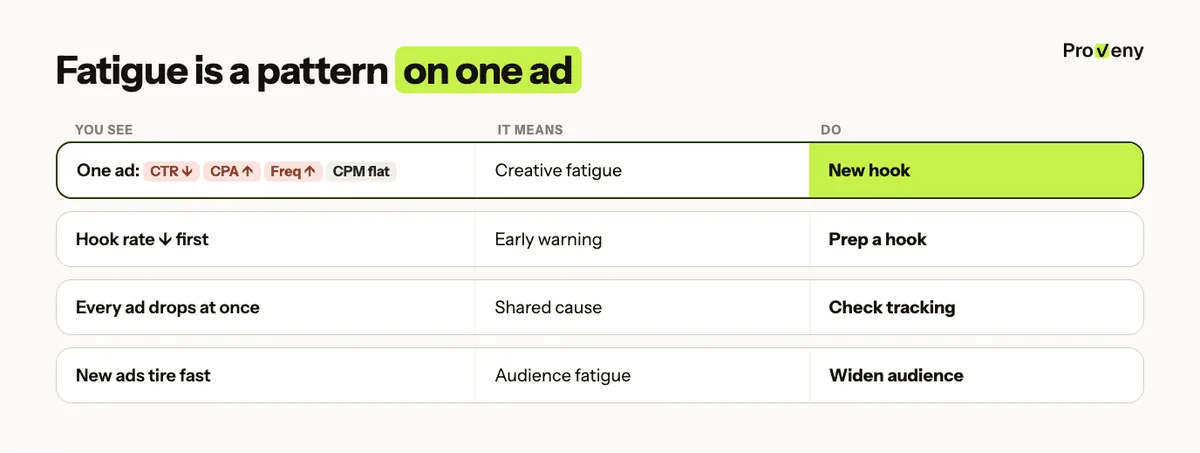
Hook rate is often the first number to move, because the opening is what people recognise. A falling hook rate with a steady CTR is an early warning, and it gives you time to prepare a new hook before cost per result climbs.
There is no magic frequency number. Meta does not publish one, and the 2.5 or 3 to 4 thresholds you see in blogs are rules of thumb. Rising frequency is a warning light only when CTR and cost per result also move the wrong way. Retargeting ads often run at high frequency and still sell.
When Meta Says "Creative Limited" or "Creative Fatigue"
Meta can show Creative limited or Creative fatigue in the Delivery column of Ads Manager. According to the Meta Business Help Center, "Creative limited" means the cost per result is higher than your past ads, but less than twice as high, and "Creative fatigue" means it is twice as high or more.
Meta shows these labels only for ad sets with one creative, so their absence does not prove your ads are fresh. When you do see one, it is a strong signal. Because the labels compare with your own past ads, they flag a decline, not a cost that is too high in general.

Drama, UGC or demo ads. Any concept, any product.
Every ad shows your product working accurately.
Why Good Ads Wear Out Faster Than They Used To
Ads fatigue faster now because the ad systems push most of your budget to your best ad and reward variety across ads.
- The winner gets most of the budget: Meta and TikTok move spend to the ad that performs best. That ad reaches its audience quickly, so it also wears out quickly.
- Variety is rewarded: Meta's retrieval system, Andromeda, picks from all available ads the few that each person may see. Clearly different ads give it more options to match to different people; small variations of one video look like the same ad.
- TikTok rotates fast by design: TikTok's Smart Creative feature detects fatigue at the ad group level and pauses videos that show signs of fatigue within their first 3 to 5 days, then swaps in new ones from a waiting list.
The trade-off is built in. Concentrating spend on one winner gives you cheap results while it is fresh and shortens its life at the same time. Fewer ads do not solve that; a steady pipeline of different ads does.
A good ad still often lasts longer than teams expect. Switching off a winner after one weak day is a common and costly mistake, so the signs above are worth confirming over 7 to 14 days before acting.
How to Fix Ad Fatigue, Cheapest Step First
The fix for ad fatigue is a ladder: the cheapest change comes first, and each step up happens only when the step before does not bring results back.
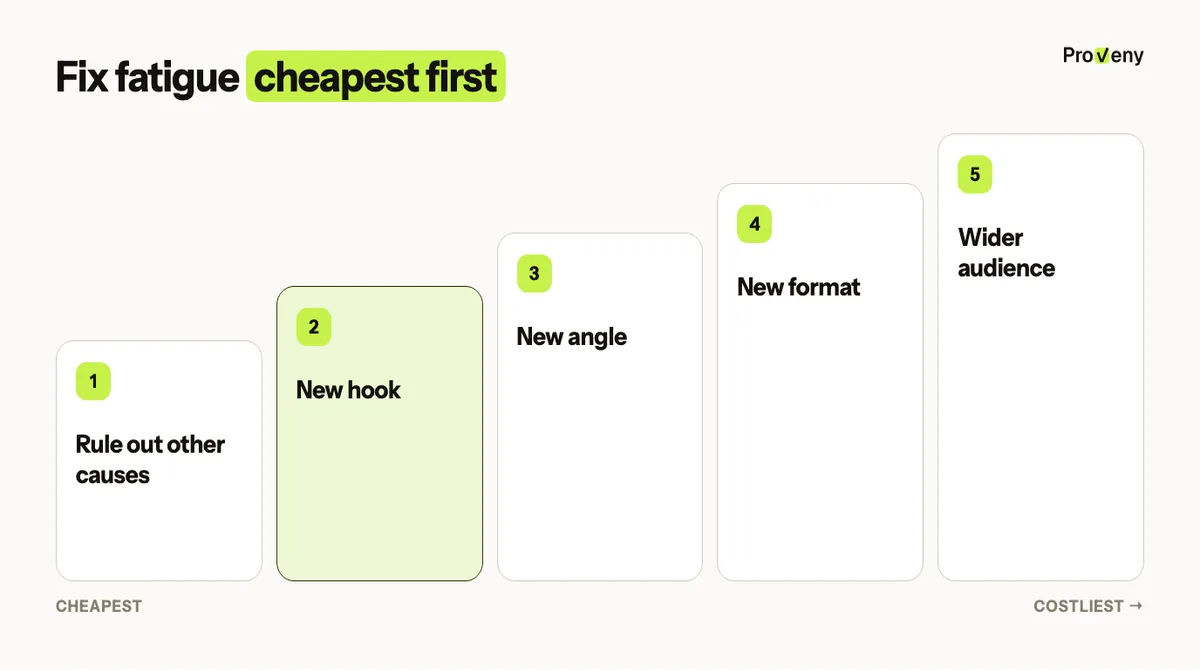
- A check for other causes Tracking, stock, price, the landing page and the season can all look like fatigue. A broken pixel or a sold-out variant shows the same falling ROAS, so these checks come before any creative change.
- A new hook on the winning ad A new hook keeps the middle and the end of the ad and replaces only the first 3 seconds. It is the cheapest fix and often enough, because the hook is the part people recognise. These TikTok hooks give ideas for openings.
- A new angle A new angle sells the same product for a different reason: time saved instead of money saved, a gift instead of self-use, safety instead of comfort. To the viewer it is a new ad, even with the same product. This is the next step when a new hook brings the hook rate back but CTR stays low, which means the reason to buy has worn out, not the opening.
- A new format A new format changes how the ad looks and sounds. If the winner was a voice-over demo, a selfie review, a two-person banter or a commercial-style ad gives the system a clearly different creative.
- A wider audience A wider audience is the fix when frequency stays high even with new creatives. That pattern means the audience is too small, so the same people keep seeing every ad.
The order follows cost. Each step up takes more production work and replaces more of what made the ad win, so climbing straight to step 4 throws away a hook or an angle that may still have life in it.
The old winner can keep running while the new versions launch next to it. The system then moves budget to whichever ad performs better, and the old ad goes off once the new ones carry the results, so sales do not dip while you wait for a replacement to prove itself.
Small edits do not count as a fix. A new button colour, a new font, one changed word in the text or a duplicate of the same ad all leave the video people already recognise. Meta's own advice in the help article above is a new ad with an image or video that is clearly different from the original.
How to Keep Ad Fatigue From Coming Back
The way to prevent ad fatigue is to add new, clearly different creatives on a schedule, before the current winner wears out.
- A weekly creative plan: A few new creatives per product every week while you scale beats one big refresh after sales drop.
- A creative bank: More finished ads than you launch means the next one is ready the day the current one tires.
- Notes on why winners win: The angle, hook and format of each winner go into a short note, so the next creatives start from what worked.
- A swipe file of other brands' ads: Long-running competitor ads show which angles last. Proveny's free ad saver extension saves them with their copy, landing page and, for Meta Ad Library ads, the dates they ran, so new angles are ready before your winner tires.
- Testing on a schedule: A short weekly test is easier than an emergency. The guide to ad creative testing shows how to set one up.
The pace of new ads should follow spend. The more an ad spends each day on the same audience, the sooner everyone in it has seen the ad, so a budget increase needs more creatives behind it, not only more money.
The common mistake is to treat creative work as a one-off project. A store that makes ten ads in one week and none for the next month is out of fresh ads exactly when its scaled winner starts to tire.


Drama, UGC or demo ads. Any concept, any product.
Every ad shows your product working accurately.
Fresh Creatives Without a New Shoot
Every fix above needs a steady supply of new, clearly different ads, and that's the part we built Proveny to handle. Fatigue is a production problem as much as a media-buying one.
You paste a product link or upload product photos. Proveny studies the product, suggests an angle and a script you approve, and renders a 15-second to 10-minute ad that shows the product actually working.
- New angles from one link: You can ask for new angles for the same product. Each one is a new concept, not a copy, which is what a fatigued account needs.
- New formats and shapes: The same product can come back as a selfie review, a hands-on demo or a voice-over ad, in 9:16 for Reels and TikTok or 1:1 and 3:4 for the feed where the product allows it.
Three Proveny ads for three products, each in a different format:
- Mosquito killer lamp (selfie review): At night in her bedroom, she shows the lamp, then opens the tray full of caught mosquitoes.
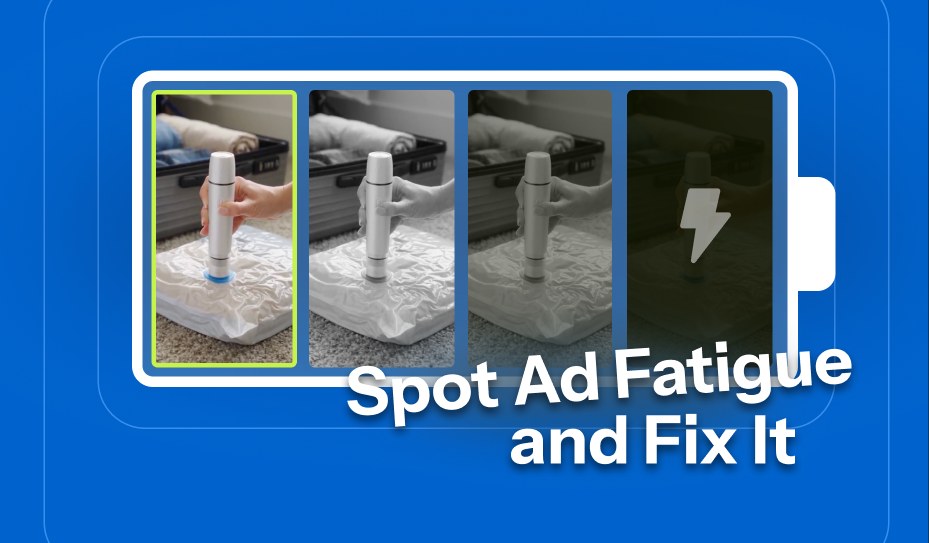
- Mini vacuum sealer (hands-on demo): Next to an open suitcase, a hand holds the small pump to a vacuum bag of clothes.
- Adjustable wrist brace (scene ad): A woman at her desk wears the brace with the dial, next to her keyboard and mouse.
Final Thoughts
Ad fatigue is repetition, not a broken ad. You spot it when CTR falls, cost per result rises and frequency climbs together over a week or two on one ad, after you rule out tracking, stock and price.
The fix runs from cheap to expensive: a new hook, a new angle, a new format, and only then a wider audience. Small edits like a new headline or button colour do not count as a new ad.
The lasting answer is a habit: a few new, clearly different creatives per product every week, so a fresh ad is always ready before the current winner wears out.
 HC
Written by
Founder of Proveny & TrueProfit
Harry Chu has spent 11 years in eCommerce doing the work behind the growth: running ads, testing creatives, reading the numbers, and scaling his own Shopify stores to 7 figures. He knows a good-looking ad account doesn’t mean much if the store isn’t growing.
Harry is the founder of Proveny and TrueProfit. On the Proveny blog, he shares what he’s learned from building and scaling his own stores: what to test, what the results actually mean, and when it’s time to stop spending on an idea that isn’t working.
No magic formula. No advice from the sidelines. Just practical lessons from someone who has had to make the numbers work in his own business.
More lessons from Harry