On this page
Quick Recap
- The UGC ads that sell physical products show the product working in a real hand within the first 3 seconds, because a viewer decides to stay or scroll before any voice-over can explain the product.
- A UGC ad feels real because it proves one claim on camera, not because it looks cheap, so shaky footage that never shows the product working still fails.
- The format should follow what the product does on camera: a product with a mechanism needs a hands-on demo, a visible fix suits problem to solution or before and after, and a result that cannot be filmed, such as comfort or sleep, needs a testimonial.
- A fair test uses two or three formats that answer different buyer doubts, because two close cousins, such as a demo and a tutorial, tell you little about whether the product itself can sell.
- The cheapest path is to find the winning format with AI-made or self-shot ads, then pay creators to film more of that one format, since a creator brief written around a proven hook wastes far less money.
What the UGC Ads That Sell Have in Common
A UGC ad works when it looks like a real customer's phone video and proves one claim on camera. The format changes, but the same four parts appear in almost every UGC ad that sells:
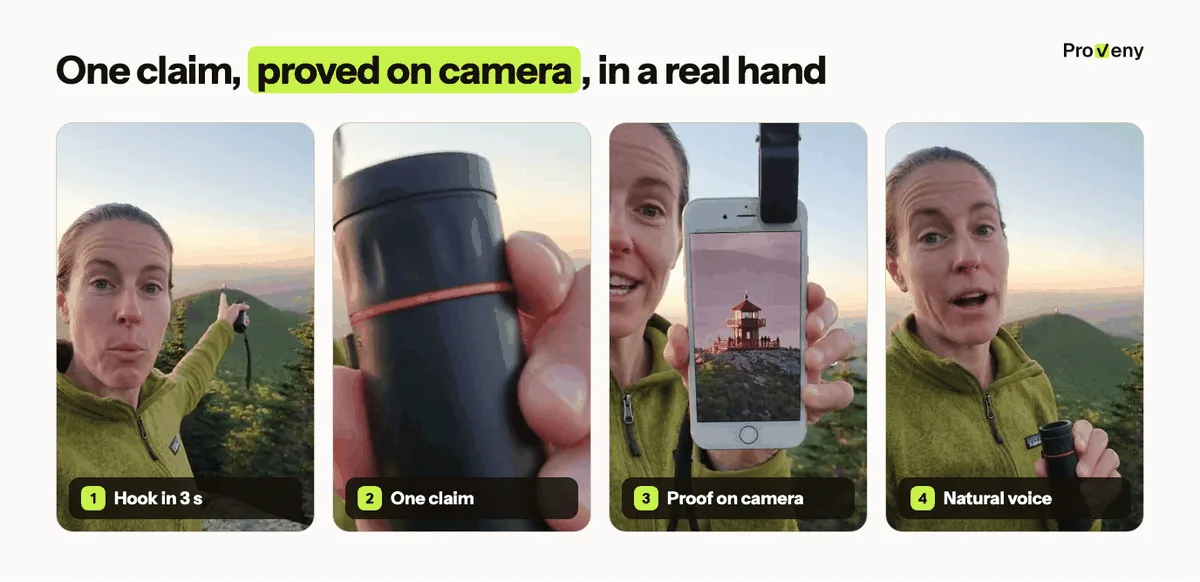
- A hook in the first 3 seconds: The problem, the result, or the product doing something unexpected.
- One clear claim: "It keeps coffee hot all day", not five features at once.
- Proof on camera: The product doing the thing, close up, in a real place.
- A natural voice: Phone camera, real room, plain words. Polish makes it look like a brand ad again.
The 3-second rule matters most. If the first shot does not stop the scroll, the rest of the script never plays. For opening lines, see TikTok hooks.
The claim also decides the shots. Once you pick "it keeps coffee hot all day", the proof shot writes itself: steam from the cup at the end of a long day. The usual mistake is the reverse, filming nice footage first and adding a claim later, which gives a pleasant video that proves nothing.
"Real" is about proof, not low quality. A selfie video with bad light and no clear product shot reads as amateur, not authentic, and it loses to a clean phone video that shows the product doing its job.
10 UGC Examples You Can Copy, With Scripts
Here are all 10 side by side, with the buyer doubting each format's answers, so you can shortlist two before reading the scripts.
| Format | Best for | Buyer doubt it answers | |
|---|---|---|---|
| 1 | Unboxing or first use | Gadgets, beauty tools, gifts | "What do I actually get?" |
| 2 | Hands-on demo (POV) | Products with a mechanism | "Does it really work?" |
| 3 | Problem to solution | Products that fix one visible problem | "Will it fix my problem?" |
| 4 | Before and after | Cleaning, organising, garden, repair, beauty | "Will I see a real change?" |
| 5 | Testimonial to camera | Results that are hard to film, such as comfort or sleep | "Is it for someone like me?" |
| 6 | Skeptic to believer | Products that look too good to be true | "Is this a gimmick?" |
| 7 | Day in the life | Everyday items, such as bottles, bags and wearables | "Will I really use it?" |
| 8 | Tutorial or how-to | Products that need a short explanation | "How do I use it?" |
| 9 | Comparison ("I tried both") | Upgrades of everyday items | "Why not keep what I have?" |
| 10 | Voice-over review | Products where details matter more than a face | "Is it well made?" |
Real ads in each format for your niche are in the Meta Ad Library, and Proveny's free swipe file app for Chrome saves them in one place with their copy and landing page.
1. Unboxing or First Use
A person opens the box and tries the product for the first time, and the viewer shares the surprise.
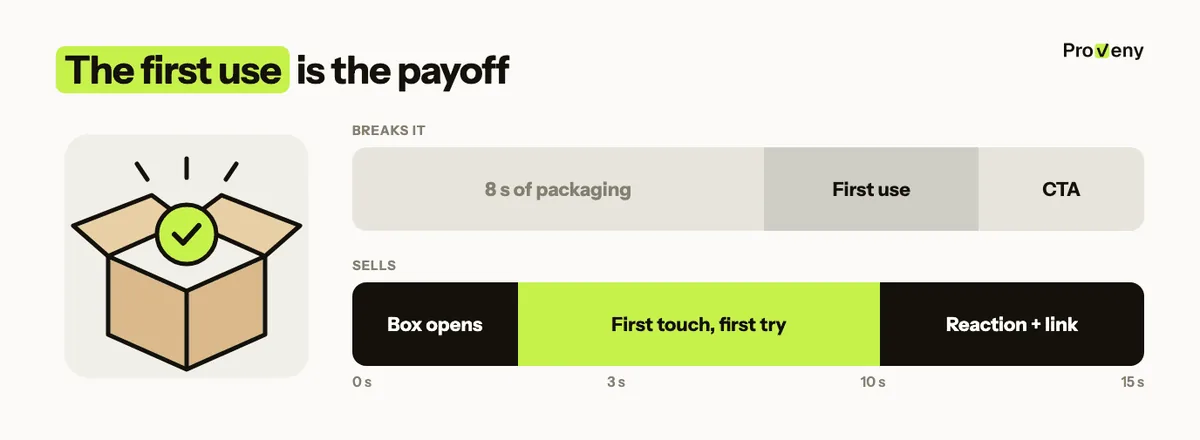
- Script: 0–3 s: "Okay, it finally came." The box opens. 3–10 s: first touch, first try. 10–15 s: a real reaction and one honest line, then "Link's below."
- Best for: Gadgets, beauty tools, gifts, anything with a satisfying first moment.
Where it goes wrong: the ad spends 8 seconds on tape and packaging. The payoff is the first use, so it should arrive by second 3 or 4; long packaging shots only sell when the packaging is part of the gift.
2. Hands-On Demo (POV)
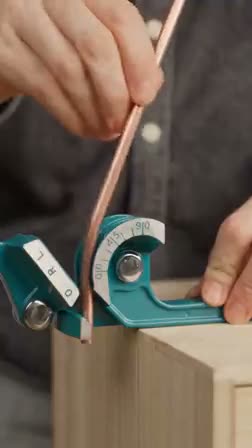
The camera is the viewer's eyes, and two hands use the product close up in a real place.
- Script: 0–3 s: the key action straight away. 3–12 s: each step, close up. 12–15 s: the result, with the product in frame.
- Best for: Kitchen tools, car accessories, cleaning products, anything with a mechanism. For more on this format, see Product demo videos.
Where it goes wrong: the key action sits at the bottom or right edge of the frame, where TikTok and Reels put captions and buttons. The hands and the moving part belong in the middle third, close enough that the mechanism is obvious without sound.
3. Problem to Solution
The problem fills the first 3 seconds, and the product fixes it right after.
- Script: 0–3 s: the problem on screen ("My dog's hair is everywhere."). 3–10 s: the product in use. 10–15 s: the clean result.
- Best for: Products that solve one clear, visible problem.
Where it goes wrong: the problem is staged so hard that it looks fake, or the fix happens in a different room. Viewers believe the solution when it happens in the same scene, on the same mess, a few seconds after the problem.

Drama, UGC or demo ads. Any concept, any product.
Every ad shows your product working accurately.
4. Before and After
The same scene appears without the product and then with it.
- Script: 0–3 s: "Before", with a text label. 3–12 s: the product working. 12–15 s: "After", from the same angle.
- Best for: Cleaning, organising, garden, repair, and beauty (see the policy note below).
Where it goes wrong: the "after" shot uses a new angle or brighter light, and viewers assume an edit. The same camera spot, the same light and the product working in between are what make the change believable.
Meta's Advertising Standards for health and wellness do not allow side-by-side "after" images for weight loss products, do not allow ads that make people feel bad about how they look, and require weight loss and cosmetic procedure ads to target people 18 or older. A quick check of the policy for your category saves a rejected ad.
5. Testimonial to Camera
A user tells the camera what changed for them, with the product in the shot.
- Script: 0–3 s: the result first ("I haven't been cold at a game all winter."). 3–12 s: the story, product in hand. 12–15 s: who it is for.
- Best for: Products with a result that is hard to show in one shot, such as comfort or sleep.
Where it goes wrong: generic praise ("I love it, it's amazing") reads as a paid script. A specific detail, such as when they use it or what they did before, carries the trust, and a cutaway of the product in use keeps the ad from being only a talking head.
6. Skeptic to Believer
The person starts doubtful and changes their mind on camera, which answers the viewer's own doubt.
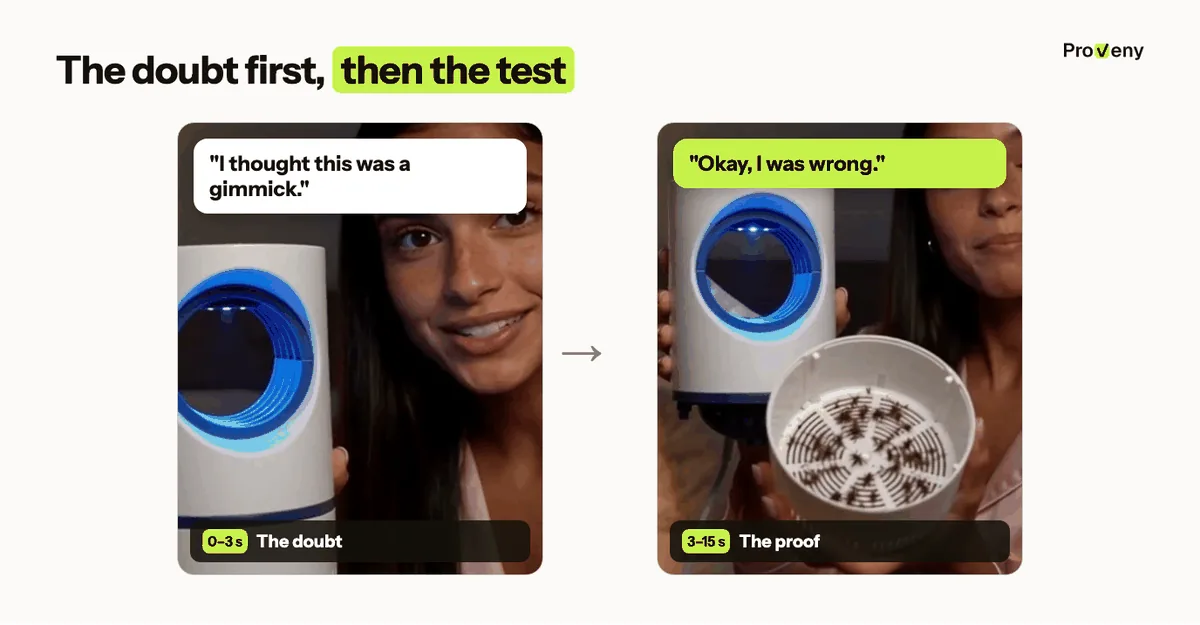
- Script: 0–3 s: "I thought this was a gimmick." 3–10 s: a hard test of the product. 10–15 s: "Okay, I was wrong."
- Best for: Products that look too good to be true.
Where it goes wrong: the "hard test" is softer than normal use. The format only works when the test is the exact thing the viewer doubts, such as the stain they think will not come out.
7. Day in the Life
The product appears in a normal routine: morning, commute, gym, evening.
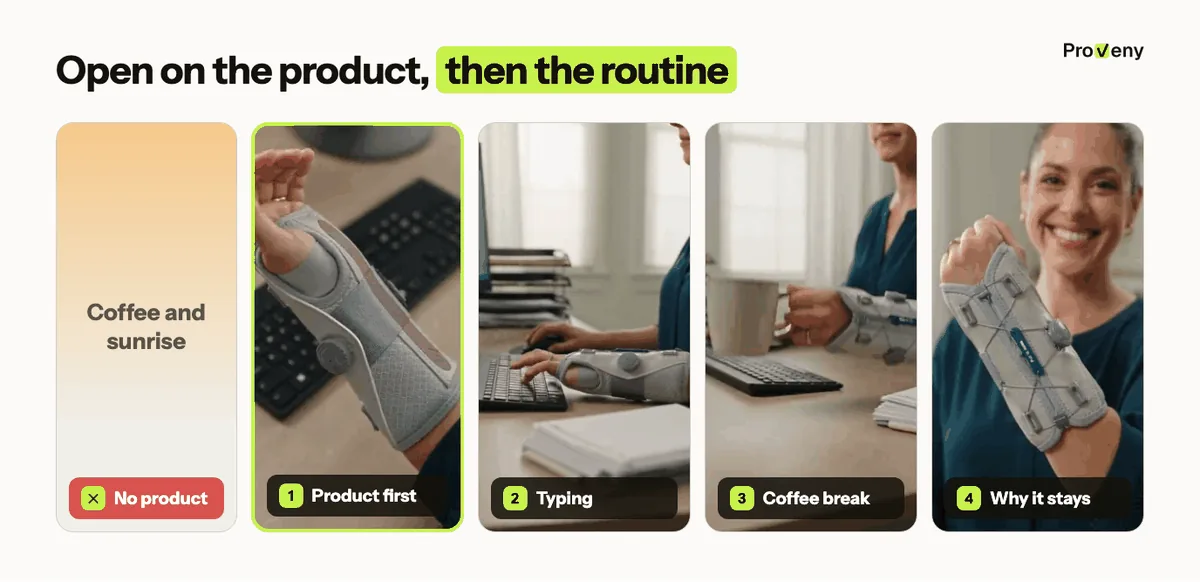
- Script: quick 1–2 second shots of the day, the product in 2 or 3 of them, and one line about why it stays in the routine.
- Best for: Products used every day, such as bottles, bags, wearables and skincare.
Where it goes wrong: the product becomes background and the first shot is a coffee or a sunrise. It works better as a second format to test than as the first, and the product belongs in the opening shot so the hook still sells it.
8. Tutorial or How-To
The person teaches the viewer how to use the product, step by step.
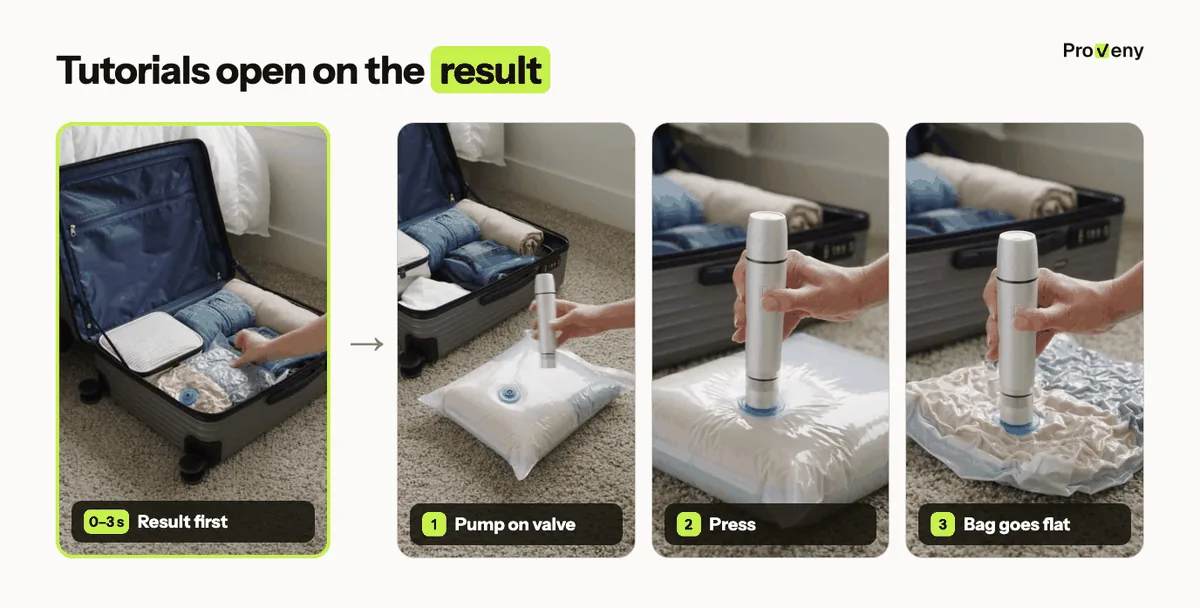
- Script: 0–3 s: "Here's how to [result] in 10 seconds." 3–13 s: three numbered steps. 13–15 s: the result.
- Best for: Products that need a short explanation, or that buyers might use wrong.
Where it goes wrong: the cold ad opens on step one instead of the result. A tutorial also earns its keep after the sale: on the product page or in post-purchase emails it prevents the misuse that turns into returns.
9. Comparison: "I Tried Both"
The product sits next to the usual way of doing the job, or next to a cheaper option.
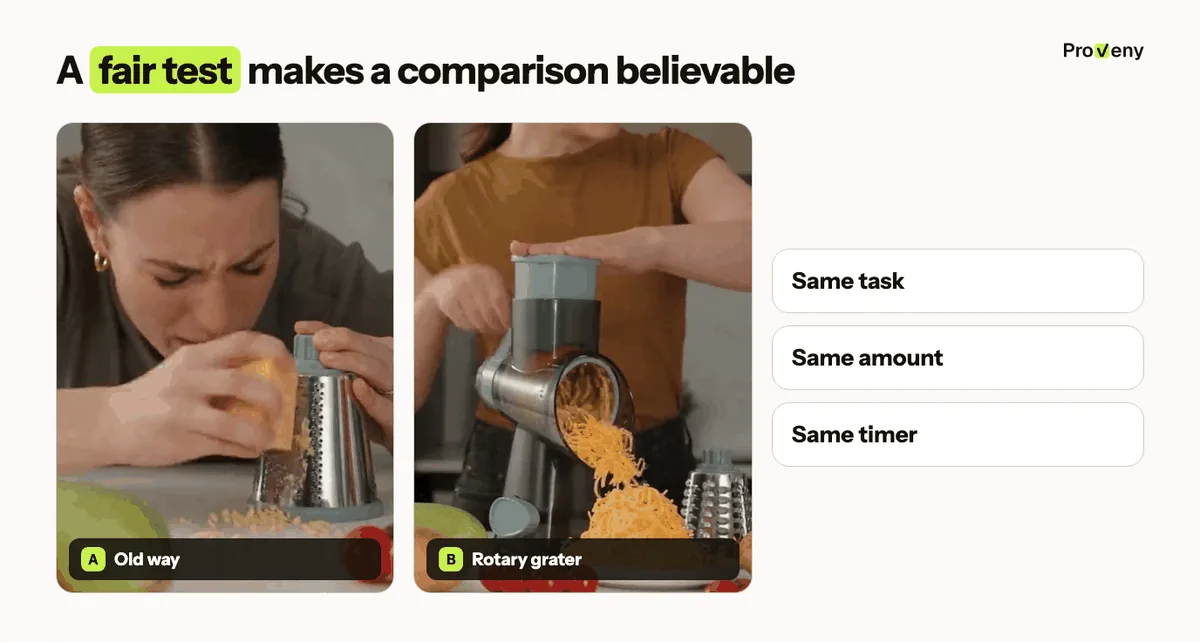
- Script: 0–3 s: two items side by side. 3–12 s: the same test on both. 12–15 s: the winner.
- Best for: Upgrades of everyday items. A comparison with "the old way" is safer than one with a named brand, because you cannot always prove a claim about another company's product.
Where it goes wrong: the two items get different tests or different conditions. The same task, the same amount and the same timer make the result fair enough to trust.
10. Voice-Over Review
No face appears on camera; a voice talks over close-up shots of the product in use.
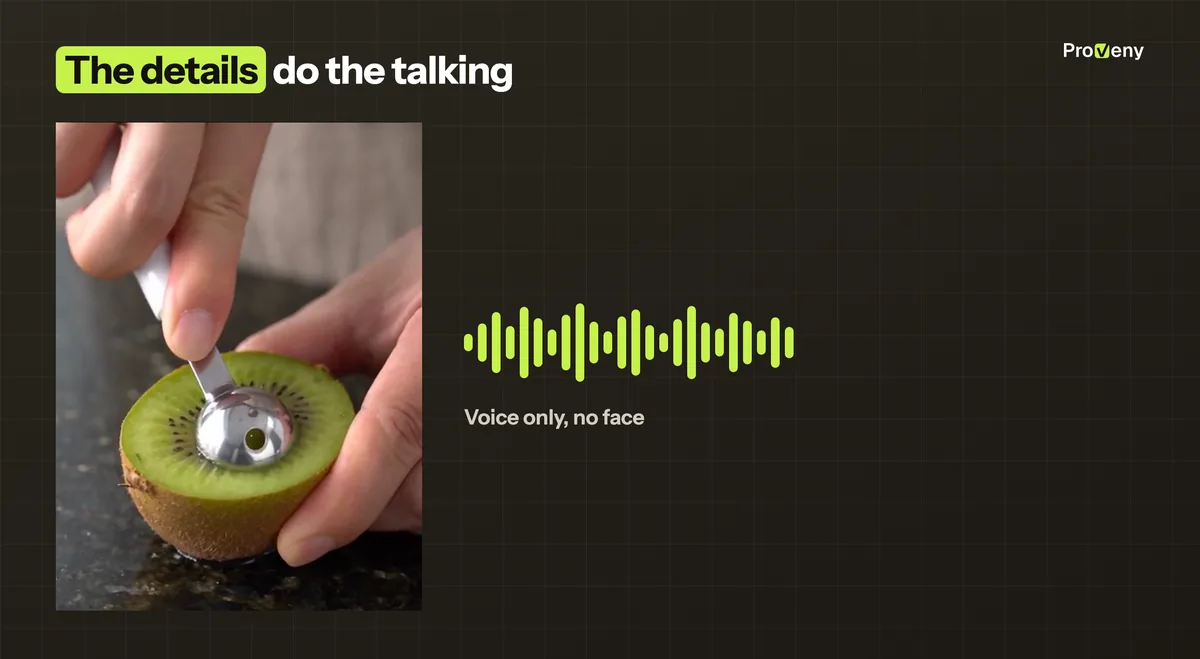
- Script: a calm first-person voice over 5 or 6 detail shots, one benefit per shot, then a final hero shot.
- Best for: Products where hands and details matter more than a face, and sellers who want a softer, review-style ad.
Where it goes wrong: the voice sounds like an announcer. A plain, conversational voice keeps the review feel; a polished read turns it back into a commercial.
Which UGC Format to Test First for Your Product
The right first format depends on what your product does on camera. The table gives a starting format and a second one to test against it:
| Start with | Then test | |
|---|---|---|
| Has a clear mechanism (folds, clips, sprays) | Hands-on demo | Problem to solution |
| Solves one visible problem | Problem to solution | Before and after |
| Looks too good to be true | Skeptic to believer | Comparison |
| Is a gift or has nice packaging | Unboxing | Testimonial |
| Is used every day | Day in the life | Voice-over review |
| Needs a short explanation | Tutorial | Hands-on demo |
The second format should answer a different doubt from the first. A demo answers "does it work"; a testimonial answers "is it for someone like me". Testing two formats that answer the same doubt tells you about the edit, not about the product.
The results then point to the next step. If one format clearly wins, three to five new hooks on that format come next, before any new format. If both formats get people to watch but nobody buys, the page, the price or the offer is the likely problem, not the format. Ad creative testing explains how to read the results.
Making UGC Ads Without Hiring a Creator
You do not need to ship a sample to a creator for each format. There are three common ways to get UGC-style ads:
| Good for | Weak point | |
|---|---|---|
| Hire UGC creators | Real faces, real voices, real reactions | Each video needs a sample, a brief and days of waiting |
| Film it yourself | Full control and low cost | Needs the product in hand and your own time to shoot and edit |
| An AI video tool | Many formats per product, fast | Must show the product correctly, or the ad loses trust |
For most product tests, the cheaper order is to find the winning format with AI or self-shot ads first, then pay creators to film more of the one that sells.
The order matters because of what each option costs per idea. A creator video costs the same whether the format wins or loses, so paying creators before you know the format means paying full price for the losing tests too. Once a format wins, the creator brief can copy its exact hook, claim and proof shot, which is the brief most likely to come back usable.
An AI-made ad has its own test before it runs: the product's moving part must move the way the real one does. A grater that turns the wrong way or a clip that bends through solid plastic costs more trust than a plain ad would.


Drama, UGC or demo ads. Any concept, any product.
Every ad shows your product working accurately.
Turn One Product Link Into Several Formats
Every format above needs one thing a supplier photo cannot give you: the product moving in a real hand. That is the part we built Proveny to make.
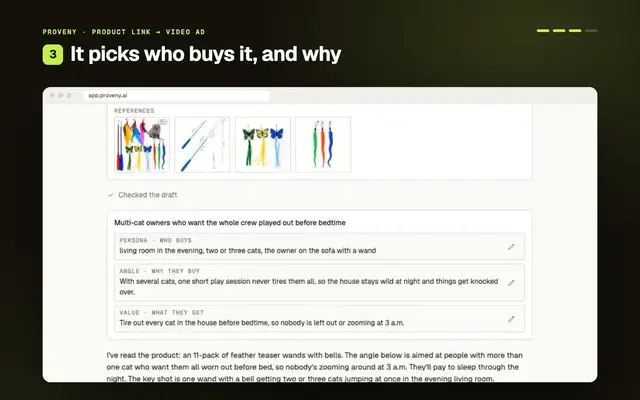
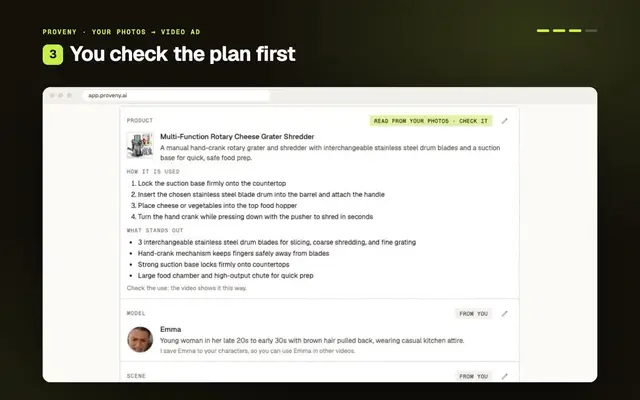
You paste a product link or upload product photos and ask for the format you want, for example "Create UGC ads for this product as a skeptic-to-believer selfie". Proveny studies the product, suggests a selling angle and a script you approve, and renders a short vertical ad that shows the product actually working. You can watch more AI ad examples made this way, sorted by format.
- Formats from this list: you can name a format in the chat, such as a hands-on demo, problem to solution or before and after, and Proveny writes the script around it. Selfie review, banter and voice-over styles are built in, so one product link can feed a two- or three-format test.
- Product analysis first: Proveny learns the product's look, the problem it solves and how people use it, so the demo shows the right motion, not a frozen photo.
- Script approval before rendering: You check the angle and every line before the video is made.
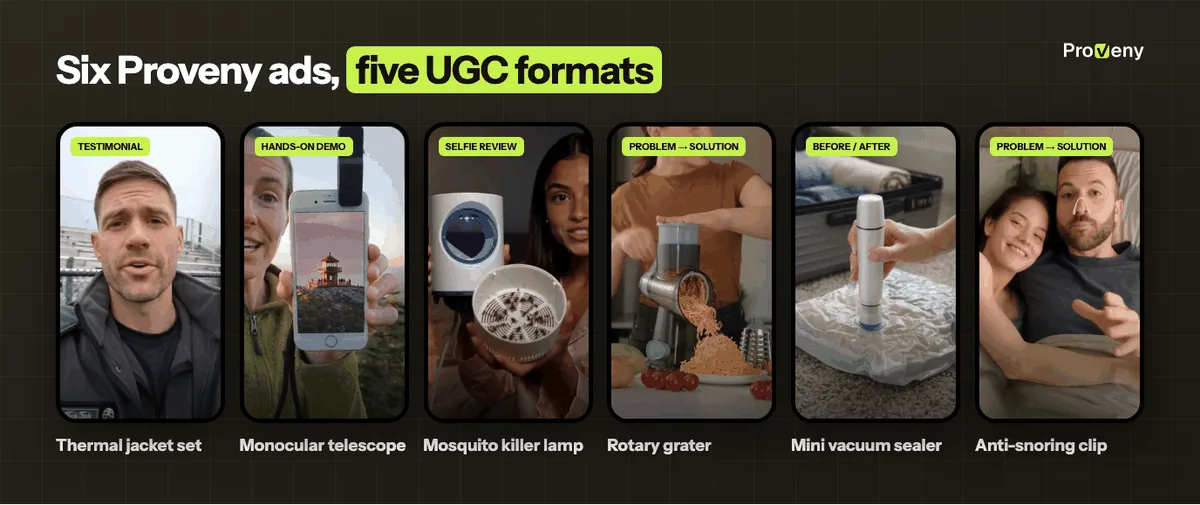
Here are six ads Proveny made, with the format of each:
Final Thoughts
The UGC examples that sell physical products are the ones that prove the product works: a demo, a problem fixed, a before and after, a real first use. A script with a 3-second hook, one claim and proof on camera matters more than a famous face.
The next step is simple: the starting format from the table for your product, one more format that answers a different doubt, and more hooks on whichever one wins.
 HC
Written by
Founder of Proveny & TrueProfit
Harry Chu has spent 11 years in eCommerce doing the work behind the growth: running ads, testing creatives, reading the numbers, and scaling his own Shopify stores to 7 figures. He knows a good-looking ad account doesn’t mean much if the store isn’t growing.
Harry is the founder of Proveny and TrueProfit. On the Proveny blog, he shares what he’s learned from building and scaling his own stores: what to test, what the results actually mean, and when it’s time to stop spending on an idea that isn’t working.
No magic formula. No advice from the sidelines. Just practical lessons from someone who has had to make the numbers work in his own business.
More lessons from Harry