On this page
Quick Recap
- The creative carries the test because broad targeting lets the platform pick the audience, and the ad is the main signal it has about who should see it.
- Every ad needs five parts: a hook in the first 3 seconds, the product's key action, a sense of size and setting, a visible result and one call to action.
- A fair Facebook test gives each product 3 to 5 genuinely different ads, the same landing page and enough spend per ad to judge it against your break-even cost per purchase.
- The supplier's listing (photos, specs, reviews, sometimes a video) is enough for a first round of ads, as long as every claim in the ad can be traced back to it.
- A product deserves a new angle before it gets dropped, and the sample is worth ordering only once an ad starts to sell.
What a Dropshipping Ad Has to Show
A dropshipping ad isn't selling a brand. It's selling one product to someone who didn't know it existed a second ago, so the ad has to answer "what is it, and does it work?" before the viewer scrolls on.
Three things make the creative matter more than anything else in the setup:
- Broad targeting is the default: with Advantage+ audience on Meta, the system uses AI to find who sees the ad, and your audience inputs work as suggestions it can go beyond. The ad itself tells the algorithm who responds.
- The product is new to the buyer: there are no reviews they recognize and no brand they trust, so proof has to come from the video.
- Winning products are made, not found: the same product can fail with one ad and sell with another, which is why one weak ad says little about the product.
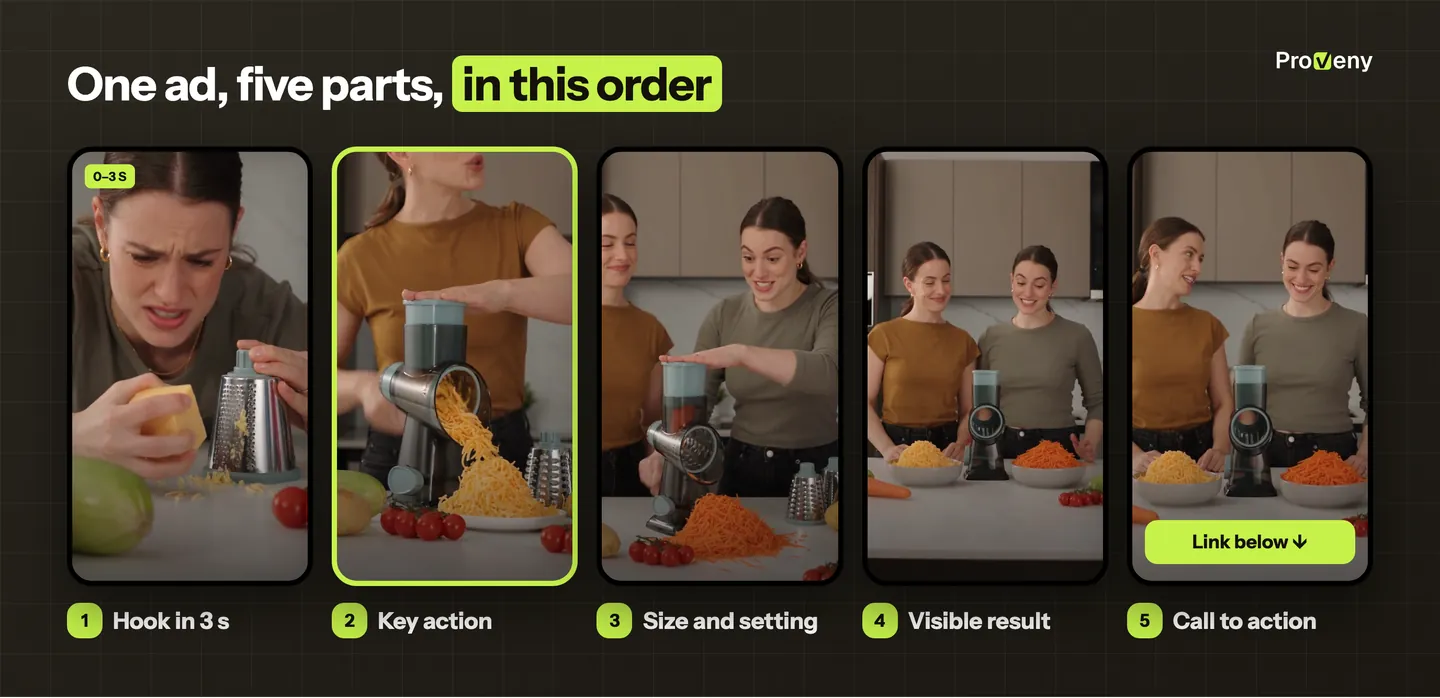
The ads that work tend to share the same five parts. Each one has a single job:
| Its job | Example | |
|---|---|---|
| Hook in 3 seconds | Stops the scroll | The problem, or the product doing something unexpected |
| The key action | Proves it works | The clip snapping shut, close up, in a real hand |
| Size and setting | Shows where it fits | Next to a phone, on a kitchen counter, in a car |
| A visible result | Gives a reason to buy | The clean floor, the dry shoe, the calm dog |
| One call to action | Says what to do next | "Link below" or the offer |
Short vertical video beats a still image for most dropshipping products, because the key action needs motion. Images still suit retargeting and products sold on looks, such as jewelry. For the shot-by-shot version of the key action, see our guide to the product demo video.
How to Set Up Facebook Ads for Dropshipping Tests
A test only tells you something if it's fair: the ads differ in a way you chose, everything else stays the same, and you know in advance what a good result looks like.
The number that defines "good" is your break-even cost per purchase: what you can pay for one sale before you lose money on it. Here is a worked example with assumed numbers:
| Amount | |
|---|---|
| Selling price | $29.99 |
| Product and shipping from the supplier | −$9.50 |
| Payment fees (about 3% plus $0.30) | −$1.20 |
| Break-even cost per purchase | $19.29 |
With that number in hand, the setup takes five steps:
- Install tracking first. Add the Meta Pixel and the Conversions API to your store, then confirm in Events Manager that test purchases arrive.
- Use one sales campaign for testing. Keep targeting broad, limited to the countries you ship to.
- Make 3 to 5 ads per product. Each one needs a different hook or angle, not the same video with new text.
- Send every ad to the same product page. Then the test is about the ads, not the page.
- Set a spend limit per ad. A common rule of thumb is about one to two times the break-even cost before an ad is judged, so roughly $20 to $40 per ad in the example above.
At three ads per product, that example works out to about $60 to $120 before you decide anything. A smaller budget is still useful, but it buys you a signal about the hook rather than a verdict on the product.
TikTok follows the same logic, with an even faster opening. Google Shopping works differently: it reaches people who already search for a product, which suits items buyers know to look for better than a new gadget nobody has heard of.

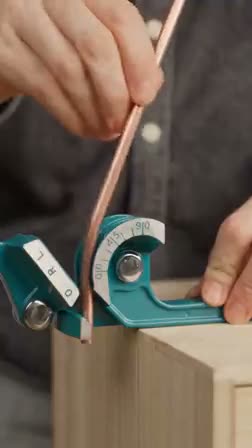
Drama, UGC or demo ads. Any concept, any product.
Every ad shows your product working accurately.
How to Make Ads Before Your Sample Arrives
Ordering a sample, waiting for shipping and filming it takes weeks. Most of what you need for a first test is already on the supplier's page: the listing photos, the specs, the product title, buyer reviews and sometimes a supplier video.
There are three common ways to turn that material into ads, and each one has a weak spot:
| How it works | Weak spot | |
|---|---|---|
| Edit the supplier video | Cut it to 15 seconds, add a new hook and captions | Other sellers often run the same footage |
| Animate one product photo | Turn a single listing image into a short clip | One photo can't show how the product works, so it often looks frozen or wrong |
| New video from the whole listing | An AI tool reads every photo and spec and shows the product in use | The script still needs checking against the listing |
The risk in all three is the same: an ad that shows something the product can't do. A buyer who sees a "waterproof" bag survive a downpour in your ad and then watches it soak through will ask for a refund and leave a comment other buyers read. That costs more than a weaker ad would have.
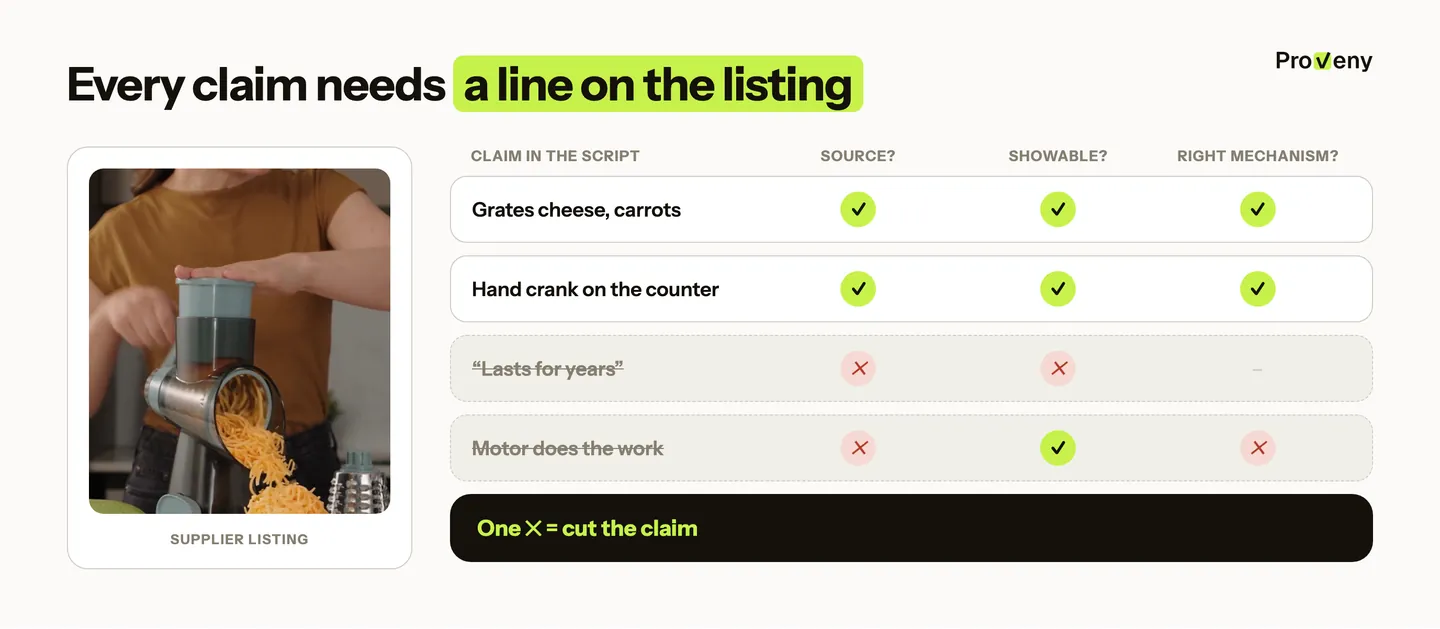
The fix is a listing truth check before anything goes live. For each claim in the script, it's worth asking three questions:
- Where does it come from? Every claim needs a source on the listing: a spec line, a photo or a pattern in the buyer reviews.
- Can the video show it? A claim the video can't show, like "lasts for years", reads as a promise nobody tested.
- Is the mechanism right? The way the product opens, folds or clips in the ad has to match the photos, because buyers notice the difference the day it arrives.
A claim that fails any of the three comes out of the script.
How to Read the Results: Scale, Change or Drop
Once every ad has reached its spend limit, the numbers usually fall into one of four patterns. Each one points to a different next step:
| What it usually means | Next step | |
|---|---|---|
| Purchases at or under break-even cost | The ad and the offer both work | Scale slowly and make new hooks for the winner before it tires |
| Strong hook rate and click-through rate, few purchases | The ad works; the page, price or shipping doesn't | Fix the product page and the offer before changing the ad |
| Low hook rate on every ad | The openings don't stop the scroll | Test new openings or a new angle before dropping the product |
| No sales after two rounds of new angles | The product, not the ad, is the problem | Drop it and move to the next product |
The third row is where products get dropped too early, because a product with three weak hooks hasn't been tested yet; only its openings have. Our guide to ad creative testing goes deeper into the metrics behind each row.
The sample becomes worth ordering when an ad starts to sell. At that point it lets you check quality before you scale, film real footage of the winner and make new versions of an ad that already works.
How to Make Several Product Ads From One Supplier Link
A fair test needs several genuinely different ads per product, and every one of them has to show the product working the way it really does. Filming that takes a sample you don't have yet, and animating a single listing photo is exactly where the mechanism breaks.
That's the problem we built Proveny to solve, for any store that sells physical products: store builders, agencies, media buyers and the sellers testing products themselves. You paste a product link from AliExpress, Shopify or another store, or upload product photos, and Proveny reads the specs, how the product is used and its images.
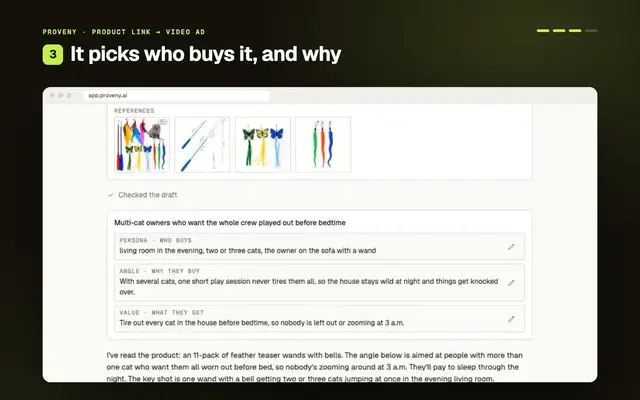
It then suggests selling angles, each built around one key action, with the visual proof that must appear and the claims the ad must not make. That last field does much of the listing truth check for you, and you can still change any line of the script before the video renders. The result is a 15-second to 10-minute ad in 9:16, or 1:1 and 3:4 for most products, with captions.
Two features matter most for a product test:
- Several angles from one link: the chat writes three different selling angles for each product, so each ad in the test can use a different angle, not the same ad with new text.
- Reshoot one segment: when a single shot is off, the editor remakes only that part, so one bad second doesn't cost a whole new video.

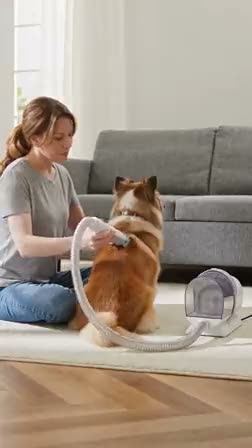
Drama, UGC or demo ads. Any concept, any product.
Every ad shows your product working accurately.
Final Thoughts
Dropshipping ads carry almost the whole weight of a product test, because broad targeting hands the audience choice to the platform and a new product has no brand to lean on.
Each ad needs a fast hook, the product's key action, a sense of scale, a visible result and one call to action. A fair Facebook test gives each product 3 to 5 different ads, one landing page and a spend limit tied to your break-even cost per purchase.
The first ads can come from the supplier's listing, as long as every claim passes the truth check. The results then tell you whether to scale, fix the page, try a new angle or move on, and the sample waits until an ad sells.
A product deserves a real test before it's dropped, and a real test starts with ads that show it working honestly.
 HC
Written by
Founder of Proveny & TrueProfit
Harry Chu has spent 11 years in eCommerce doing the work behind the growth: running ads, testing creatives, reading the numbers, and scaling his own Shopify stores to 7 figures. He knows a good-looking ad account doesn’t mean much if the store isn’t growing.
Harry is the founder of Proveny and TrueProfit. On the Proveny blog, he shares what he’s learned from building and scaling his own stores: what to test, what the results actually mean, and when it’s time to stop spending on an idea that isn’t working.
No magic formula. No advice from the sidelines. Just practical lessons from someone who has had to make the numbers work in his own business.
More lessons from Harry